
Public Bike Maintenance Station: How to Choose One
- Published on 4 Sep 2026
A flat tire on the way out of the office, a saddle that needs adjusting before setting off again, a loose bolt along a bike path: these are minor inconveniences that often interrupt a trip or spoil the experience for cyclists. A public bike maintenance station transforms these moments into an immediate, visible, and self-service solution. For a municipality, a company, a lodging facility, or an operator of spaces open to the public, it’s not just an accessory—it’s infrastructure that makes cycling more reliable.
The choice, however, cannot be based solely on the number of tools. Location, durability, accessibility, integration with parking and charging stations, long-term support, and aesthetic consistency determine the true value of the investment. A good station must be ready for use when needed, easy to understand, and capable of withstanding heavy use.
Why a public bike maintenance station changes the experience
People who use bicycles for work, school, tourism, or leisure aren’t necessarily looking for a full-service repair shop. They’re looking for a way to quickly fix a common problem without having to detour, miss an appointment, or load their bike into a car. An efficient pump and essential tools can make the difference between a ride cut short and a journey that continues.
That’s why a well-located maintenance station provides a benefit that goes beyond repairs. It demonstrates genuine care for cyclists, employees, guests, and visitors. It enhances the perception of a place’s quality, supports sustainable mobility policies, and encourages daily bike use by reducing one of the most common barriers: uncertainty when faced with minor breakdowns.
In urban areas, the service can complement a transit hub, a plaza, a school, a park, or a bike path. In a corporate setting, it becomes part of a wellness and mobility management program. At campgrounds, hotels, and cycling destinations, it enhances the welcome for travelers with traditional bikes, e-bikes, cargo bikes, or family bikes. The principle is the same, but the setup must adapt to the context.
What an Effective Station Must Offer
A public bike maintenance station should address the most common issues, not attempt to replace a specialized mechanic. The goal is to enable simple, quick, and intuitive maintenance tasks: inflating tires, making adjustments, tightening bolts, and performing minor repairs.
At the heart of the equipment is a sturdy pump, compatible with the most common valve types and easy to read even for non-experts. A clear pressure gauge helps prevent under- or over-inflation—a particularly useful feature for e-bikes and touring bikes, which are often heavier and subjected to significant loads.
The tools should be selected to cover everyday needs: hex wrenches, screwdrivers, tire levers, open-end wrenches, and tools for the most common adjustments. They must be secured with anti-vandalism systems, have cables of adequate length, and feature handles that can be used outdoors, even with cold or dirty hands. The inclusion of a stand to lift or stabilize the bike simplifies many repairs and improves rider safety.
Quality isn’t measured by the quantity of accessories. A set of essential, durable, and consistently reliable tools is worth far more than a rack overloaded with items that require constant attention. The best configuration depends on the user profile and anticipated usage patterns.
Materials and Structure: Operational Reliability First and Foremost
Outdoors, rain, sun, salt, dust, and repeated use put every component to the test. The structure must be designed to remain stable, recognizable, and functional over time. Materials suitable for public spaces, durable finishes, and reliable fasteners reduce the risk of deterioration and maintain the perceived value of the service.
Scheduled maintenance also deserves attention right from the design phase. Checking pump pressure and integrity, tool wear, cable condition, and the cleanliness and legibility of instructions prevents the station from becoming a fixture that’s present but unusable. For the user, a pump out of service means no service at all. For the operator, quick checks and readily available replacement parts are essential for operational continuity.
Where to Install It to Ensure It’s Actually Used
Location is often more critical than the station itself. An excellent but hidden device—poorly lit or far from main routes—will see little use. Conversely, a clearly visible solution placed in the right spot naturally becomes part of cyclists’ routines.
The best locations are transit and rest areas: next to bike racks or bike boxes, at business entrances, public transit stops, hospitality facility reception areas, information points, secure bike parking lots, and access points to bike paths. Sufficient space is needed to maneuver without obstructing pedestrians, cars, or other cyclists. Even pavement, adequate lighting, and simple signage improve safety and usability.
In an urban center, it may be useful to distribute several key locations rather than concentrating everything in a single area. In a tourist facility, on the other hand, it may be preferable to create a dedicated bike area near storage, washing, charging, and route information. There is no one-size-fits-all solution: the design process begins with observing traffic flows, dwell times, and the specific needs of the location.
Integration with Parking and Charging
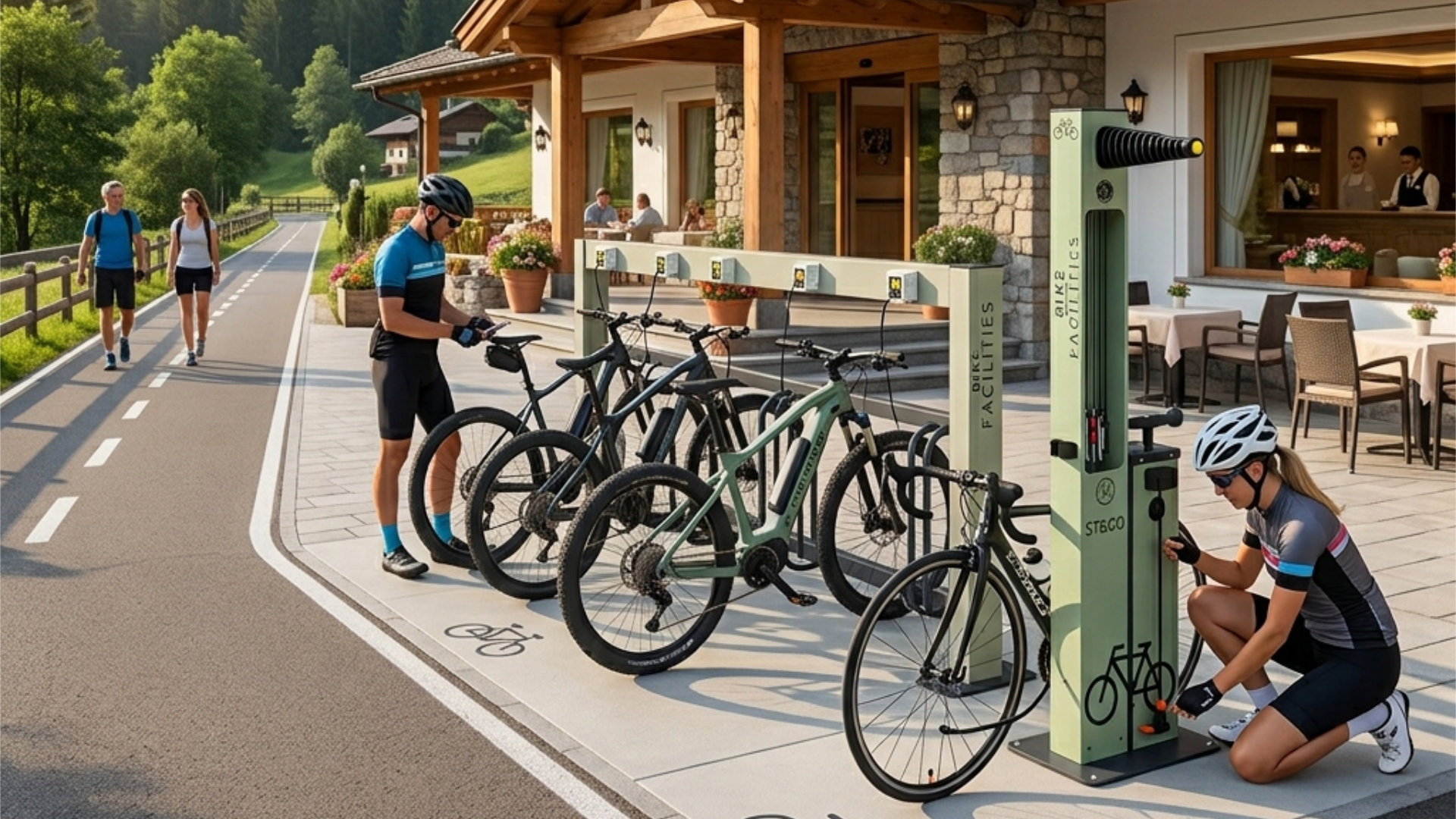
Maintenance is most effective when it’s part of an ecosystem. Someone who stops to inflate a tire often also needs a secure place to park; someone using an e-bike may need to recharge during a break. Locating the station near high-quality bike racks, charging stations, shelters, or bike stations creates a more comprehensive and organized service.
This integration offers clear operational advantages. Users can find everything they need in one place to arrive, stop, secure their vehicle, and set off again. The operator centralizes the infrastructure in an easily recognizable and manageable area. The project gains visual coherence, especially when colors, branding, and signage align with the location’s identity.
For e-bikes, it’s also important to consider practical aspects that are often overlooked: the bike’s greater weight, the presence of bags or child seats, the need for more spacious maneuvering areas, and potentially longer parking times. Designing for both traditional and electric bikes means better accommodating both types of use.
Customization, Data, and Service Management
A station can become a waypoint for navigation, not just a service point. Personalization through colors, logos, usage instructions, or references to the cycling network makes the service immediately recognizable. For municipalities and tourist destinations, this can reinforce the image of a region that is truly investing in cycling-friendly infrastructure. For companies and property managers, it demonstrates a concrete commitment to sustainable transportation.
When the project includes traffic counters or other monitoring tools, decisions can be evidence-based: which access points are most used, during which time periods traffic increases, and where new parking spaces or additional services are needed. The maintenance station alone does not generate all the necessary data, but when integrated into a smart infrastructure, it helps provide a better understanding of how the space is actually being used.
Management must also be considered. A high-traffic area requires more frequent checks than a facility on a company campus with controlled access. An exposed location may benefit from particularly durable solutions and placement near staffed areas. A seasonal campground can schedule intensive checks during peak months. The right investment is one that is proportionate to the intensity of use and the project’s objectives.
From the Device to the Mobility Project
Choosing a maintenance station means designing a point of trust along a person’s journey. Bike Facilities addresses this need by integrating assistance, parking, charging, safety, and the quality of the space, thereby creating modular solutions capable of evolving with the location and its users.
Before making a choice, it’s wise to ask concrete questions: Who will be cycling here? How long will they stay? What services are already available? What challenges currently prevent people from cycling more regularly? The answers guide the station’s size, equipment, location, and support plan. A well-designed station doesn’t promise to fix every problem—it enables people to overcome the most common issues and continue on their way. Keep on moving.

Our catalogue
Discover our products
Similar articles
Events and News
We love staying up-to-date on industry news and attending trade shows...come visit us!

